Commercial · Markham
Master Key System Design
A new hire at the shop gets handed whatever spare key happens to be in the drawer, and it turns out to open the stockroom, the back office and the safe room all at once.
In plain words
A property that expects to add doors, departments or locations benefits from a master key system built with room to grow. Master key system design accounts for that from the outset: the keying platform and combinations chosen leave spare capacity for realistic future openings, rather than filling every available combination on the first day. That way, a new office, a new hire, or a newly leased unit can usually be added to the existing chart instead of triggering a redesign of levels that are already in use elsewhere in the building.
How the visit goesA dental office wants the front desk to lock up at night without ever holding a key to the room where patient records and controlled supplies are stored. Right now one master key opens both, which nobody is comfortable with once it is pointed out.
Master Key System Design
How the visit goes

What a shared or multi-tenant building already has in place
Where the property sits inside a larger building, the check looks at what is already shared: a condominium corporation's own lobby or garage system, a landlord's building-wide master, or another tenant's separate keying. The new hierarchy is designed to sit alongside those systems rather than to cut across them, so a tenant's own suite keeps its own private levels while common areas continue to answer to whoever already manages them. Sorting this out first avoids designing a system that quietly conflicts with access someone else controls.
Working around a building that is already occupied
In an occupied property, doors are rekeyed in a planned order rather than all at once, so a department is never left without a working key partway through a shift. Interim arrangements, such as a temporary key for a door being converted to a new level, are agreed in advance and closed out the same visit they are used. This staged approach lets a business keep operating through the change instead of losing access to parts of the building while the new hierarchy is being built.
Handing the record to whoever administers it next
The chart, the issuance log and any spare keys are handed to a named administrator, not left as loose paperwork or scattered across whoever happened to be present. If that role changes hands, custody of the record moves with it deliberately, along with a signed acknowledgement of what is being transferred, so the system's history does not quietly disappear along with the person who used to manage it.
Master Key System Design
In the van
Bench test fixture
Master pin kits
Cylinder decoders
Key marking tools
Change and master keys
Master Key System Design
What affects the quote
Testing scope before handover
Testing every cylinder individually and then testing each master and sub-master across its full group takes time proportional to how many doors and levels exist. A larger hierarchy with more levels to verify against more doors adds to that testing time.
Number of doors and levels involved
A single office with one change key and no sub-master is a simpler project than a multi-floor property with several departments and a top-level master. The quote reflects how many doors are assessed, how many levels are designed, and how many cylinders are pinned to match those levels.
Working around an occupied, operating property
Rekeying doors in a planned sequence so a business keeps operating throughout, rather than all at once, takes coordination with the owner's schedule. Properties that need this staged approach, with interim arrangements for doors mid-conversion, add planning time beyond a straightforward, all-at-once installation.
What to have ready
- Do any doors already use keypad or card-based access?
- Do any doors need restricted or patented keys for duplication control?
- Roughly how many doors need to be part of the system?
Master Key System Design: questions
QuestionsWhat is the difference between a master key and a sub-master?
A sub-master sits below the top level and opens a defined group, such as one department or one floor, without opening doors outside that group. The top-level master sits above every sub-master and opens everything in the system. Most properties need only one or two sub-master levels; adding more than the business genuinely uses just makes the chart harder to manage without adding real convenience.
Can a master key system be expanded later without redesigning it?
Usually yes, if spare capacity was planned into the keying platform from the start. A new hire is normally handed a copy of the bitting their role already calls for, and a realistic new door can be pinned to accept a combination already reserved for that purpose. A system pinned to its absolute limit on day one has less room to grow, and adding a level to existing doors later can mean repinning cylinders that are already in daily use.
How is accountability maintained when several people hold different levels of keys?
Through the chart and issuance log rather than memory. Each level is tied to named roles or people, each key is marked to reflect its level rather than the door it opens, and any change of hands is recorded with a signed receipt. That record names every authorized holder for a door, though it can only account for a key that was never copied, loaned or picked up by someone outside that list.
Related services
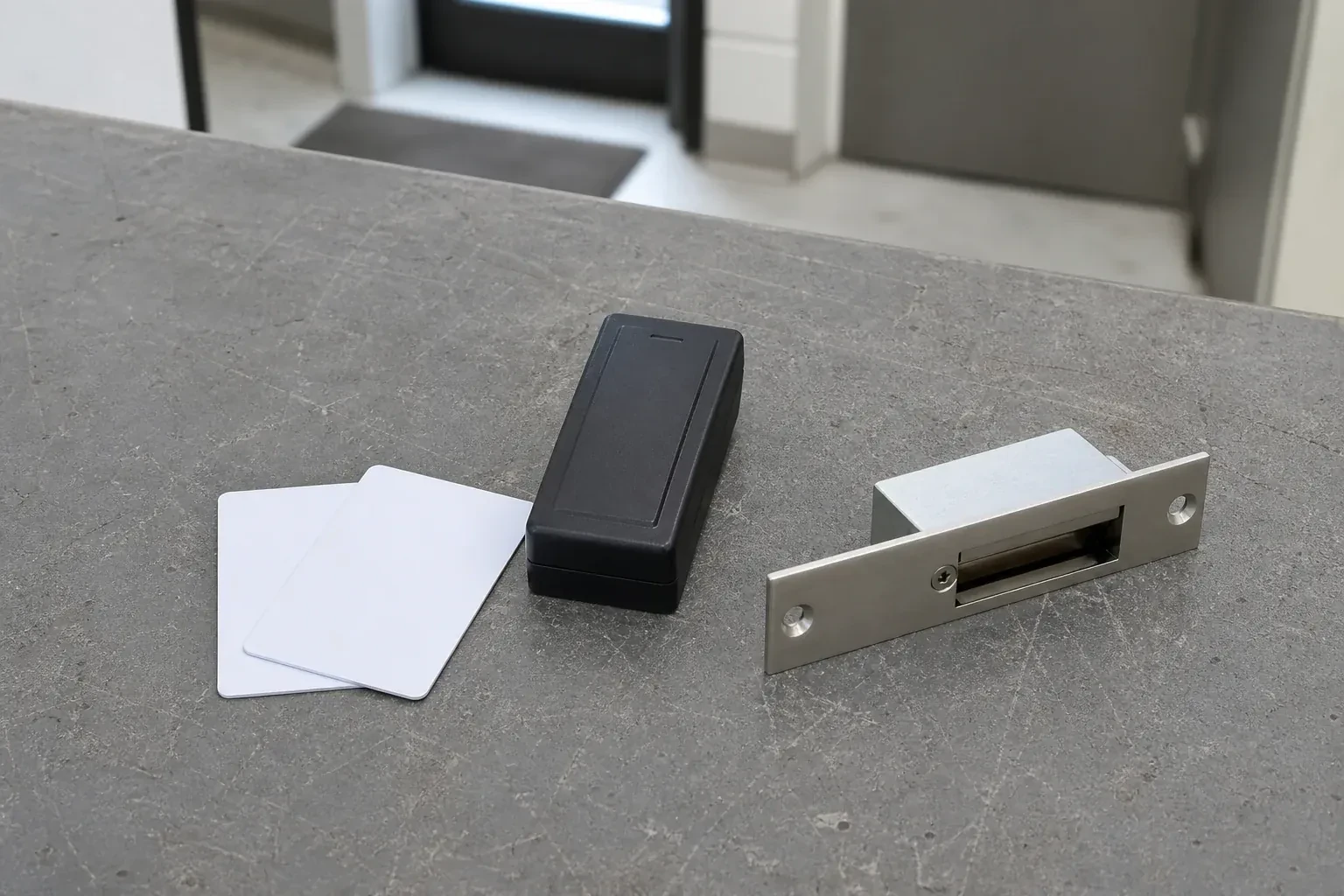
- Access Control InstallationSomething went missing from the storeroom over a weekend, and when you ask who was in the building, the honest answer is anyone with a key.
- Panic & Exit HardwareThe fire inspector's note is blunt: the banquet hall's second exit still turns on a deadbolt, and the crowd it is rated to hold needs a door that opens under one motion, no key involved.
- Commercial-Grade Lock ReplacementThe key to the office entrance turns with almost no resistance now, and some mornings the deadbolt does not fully retract until someone jiggles the handle and tries the key again.